Grana mountain village
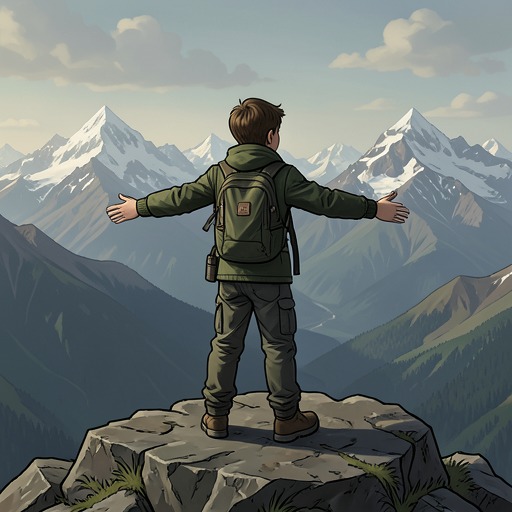
The Eight Mountains: A NovelGrana mountain village is both a remote valley settlement and the point from which Pietro’s memories of Bruno, his father, and the mountains take shape. First encountered in July 1984, it becomes a childhood territory organized around a river and a few familiar households; years later, the altered valley and the traces left by Pietro’s father make it a place where remembered life can be recovered, though never restored unchanged.
Setting and First Encounter
Grana mountain village lies at the edge of a valley that passersby treat as irrelevant, enclosed by iron-gray peaks above and a cliff that obstructs access from below. Ruins of a tower stand on the cliff among overgrown fields. The road leaves the regional trunk route and climbs steeply in circles to the tower before turning along the mountain flank and entering the valley halfway up. The route itself makes the village feel set apart: the valley is concealed from below, then opens beyond the climb into a larger landscape than the approach suggests.
Pietro first travels this road with his mother in July 1984, when hay is being cut in the fields. The shaded side of the valley is forested, while the sunny side is terraced; below, a river appears intermittently among the bushes. The river, rather than the village houses, first catches the boy’s attention. His adventure stories, especially Mark Twain, have already taught him to imagine fishing, swimming, and making a raft, so the landscape arrives first as a promise of play and exploration.
The River and Childhood Territory
After Pietro’s father leaves, Pietro’s mother settles into a more practical daily routine in the house. She lights the stove with kindling and newspaper, serves toast and jam, washes him at the tap, and sends him outdoors in wind and rain in the hope that he will lose some of his delicate urban constitution. The river becomes the place where he spends those days, within two limits his mother can monitor from the balcony: a small wooden bridge upstream, beyond which the banks narrow into a gully, and the thickets downstream beneath the cliff.
Within those boundaries, the river seems to Pietro almost complete. It first rushes over crags and between huge rocks, where he peers down at silver reflections. Farther on, it slows and meanders around birch-covered islets that he can leap across. A jumble of timber finally blocks the water, left by a winter avalanche that Pietro does not yet understand. He reads the obstruction as a point where the river has stopped and stagnated, and repeatedly sits watching weed undulate below the surface. The sequence of rapids, islands, and barrier gives the childhood landscape its own geography and rhythm.
Village Life and Bruno
The riverbanks also introduce Pietro to Bruno, a boy who grazes seven restless, chestnut-colored cows in the meadows. Bruno carries a yellow plastic stick with a curved handle to prod them toward the grass; when they stray, he chases after them, and later calls them back up the slope toward the stable. In the pasture he sits above the animals carving a small piece of wood with his penknife. These practical gestures make him part of the working landscape rather than merely another child in it.
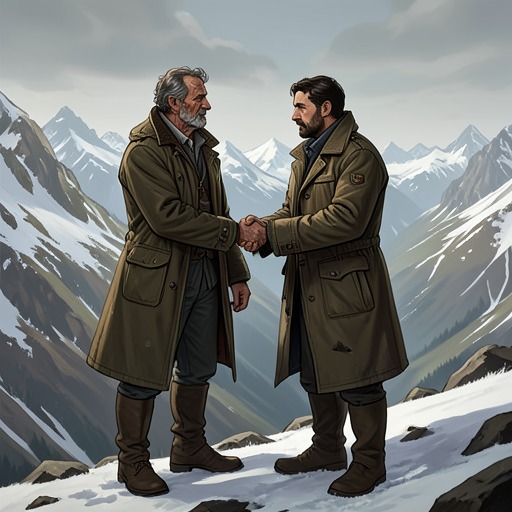
For the rest of that July, Pietro and Bruno meet every day. Pietro joins Bruno in the pasture, or Bruno strings a wire around his cows, connects it to a car battery, and comes to the house. Pietro’s mother questions Bruno directly, and he takes pride in having his story interest a city woman. He tells them he is Grana mountain village’s youngest inhabitant and its last boy, with no prospect of other children arriving. His father spends most of the year away, taking construction work in France or Switzerland and returning mainly in winter. His mother has never left the village and tends a small domain of fields, a vegetable garden, a henhouse, two goats, and beehives. Bruno lives with her in his uncle’s house; the uncle owns pastures and dairy cows and spends time in the mountains with Bruno’s older cousins.
The Adult Return
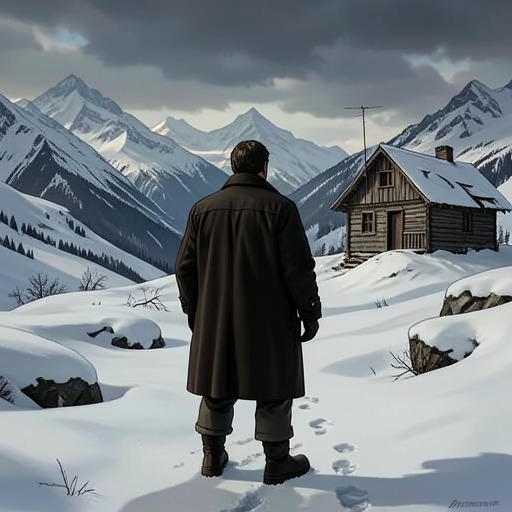
When Pietro returns alone at the end of April as an adult, he is unsure whether the place he loved as a boy will still feel familiar. The valley has changed: the road has been widened in places, protective netting covers escarpments, and felled trunks lie in piles. Tyrolean-style villas have begun to appear, while sand and gravel extraction has confined the river between cement banks where stones and trees once bordered it. Second homes are dark, hotels are closed for the season or permanently, and idle bulldozers and excavators give the valley the look of a stalled building site.
Snow on the higher mountains consoles Pietro for the deterioration below. The seasonal contrast also restores a knowledge city life has dulled: in April, going higher means going back a season. At the old house, his father’s map remains thumbtacked to the wall. Over twenty years it has accumulated routes to summits, alpine pastures, and refuges until the network is almost illegible to anyone else. The map has become a record of a life in the mountains. Pietro deciphers its black, red, and green lines: black marks his father’s routes, red accompanies the climbs made with Pietro, and green identifies Bruno. The map reveals that his father and Bruno walked together repeatedly, a discovery that brings Pietro jealousy as well as relief that his father did not spend all those years alone.
Routes, Memory, and the Mountain Home
Grana mountain village remains the starting point for routes into the surrounding heights. On a later ascent of the barren mountain above his house, Pietro finds a summit notebook and reads his father’s 1997 entry: he had climbed from Grana in three hours and fifty-eight minutes and was still in great shape. The damp, fading handwriting makes the record fragile, but its exact time preserves a vivid trace of his father’s strength and humor. The entry connects the village to the high mountain not just as a place on a route, but as the point from which his father set out alone.
The adult return does not end at the village. Pietro and Bruno build a house higher in the mountains, and Pietro brings his mother up from Grana to see it. There, on the rock wall, he has carved his father’s name and dates beside the words In memory is the most beautiful refuge. He tells Bruno that the house should belong to them both because they built it together. Grana’s significance lies partly in this passage outward: it holds Pietro’s childhood and family memories, while the rebuilt mountain home gives those memories a shared future with Bruno.